This is a summary of our new peer-reviewed longitudinal study, “The Constrained Generation: A Longitudinal Study of Adolescent Self-Esteem and the Misattribution of Harm to Social Media.” If you’d like to read more, see the full article (open access) or PDF.
Primary takeaways
Social media use in early adolescence was prospectively associated with subsequent increases in self-esteem for girls, with no significant relationship for boys.
Social media use was associated with subsequent decreases in time with family, but not friends, consistent with developmentally typical shifts toward peer socializing over adolescence. This relationship was significant for girls; for boys, a similar relationship emerged for video game play.
The positive relationship between social media use and girls' self-esteem was comparable in magnitude—but opposite in direction—to the negative relationship observed with pandemic-era lockdowns.
The "anxious generation"
Discussions of adolescent mental health have coalesced around a clear narrative: declines in adolescent well-being are attributed to smartphones and social media. The proposed mechanisms vary; social comparison, negative online interactions, and, especially, the displacement of "real world" time spent with friends and family (Haidt, 2024). The policy responses follow these claims. In 2023, the U.S. Surgeon General warned of a "profound risk of harm" to youth mental health (Murthy, 2023), and restriction has become the default solution.
Yet the evidence base is more modest than the narrative suggests. Much of the scholarship in this area reports small associations between social media and well-being (Ferguson, 2025; Hancock et al., 2022; Orben & Przybylski, 2019). In response, some maintain that these small, near-term effects accumulate into a larger "cumulative" harm over adolescence (Haidt, 2024; Twenge et al., 2022). That claim requires longitudinal evidence that follows young people across adolescence, and which accounts for everything else changing in their lives over the same period.
In our new open-access paper in SAGE Open, Dr. Keith Hampton and I test these claims. Notably, our work predates much of the current public debate: our first wave of data was collected in the spring of 2019. Rather than an "anxious generation" harmed by screens, we argue that today's youth are a "constrained generation,” and that social media use is a response to these constraints, rather than their cause.
A constrained generation
There is broad evidence of a historical shift in how adolescents spend time with peers: they engage in fewer voluntary, unstructured interactions with other young people. Popular accounts treat this shift as new—a "generational" effect tied to mobile phones and social media (Haidt, 2024; Twenge, 2017). These accounts ignore or minimize its longer-term roots. At least three mutually reinforcing structural changes predate social media and constrain young people's time, autonomy, and opportunities for unstructured peer contact.
The decline of free play.
As articulated extensively by Peter Gray (2011), opportunities for unsupervised, outdoor free play have declined since the late 1950s, accelerating through the 2000s. Moral panics surrounding crime, traffic, and "stranger danger" reshaped parenting practices, replacing free play with adult-supervised or home-based activities. This loss of autonomy corresponds with worsening long-term trends in feelings of fear, worry, and helplessness among young people (Gray, 2011).
Education reforms.
The 1994 report, Prisoners of Time, advocated for schools to "reclaim the academic day" by replacing unstructured social and leisure time with core subjects and adult-supervised, structured activities (Kane, 1994). This became a blueprint for reforms (e.g., No Child Left Behind [2001], the Common Core Standards [2010]). For young people, these changes displaced activities that otherwise support autonomy and unstructured interaction; shrinking recess, lunch, and time between classes.
Intensive parenting.
Rising income inequality is associated with the rise of intensive parenting (Doepke & Zilibotti, 2019, 2021). When parents perceive a greater threat to their children's long-term prospects, they prioritize structured, educational, adult-supervised activities—homework, sports, volunteering, school clubs—over unstructured time "hanging out" with friends. Yet, over adolescence, parental and adult relationships become less effective at buffering adverse experiences, while peer relationships become increasingly protective (Dinsmore & Pugh, 2021).
Within these constraints, social media may offer what Robinson (2011) describes as functional equivalence: a digital "stand-in" for increasingly constrained opportunities for voluntary, unstructured peer socializing. This builds on a long line of scholarship on digital youth culture, which recognizes online spaces as settings where young people develop and engage in activities free from adult oversight (Ito, 2013; Jenkins, Ito, & boyd, 2015).
Omitted-variable bias
Prior studies recognize that social media use changes over adolescence. They rarely measure change in other social activities over the same period—time spent with friends, family, and in extracurriculars. When research fails to account for these shifting social opportunities, it introduces omitted-variable bias, misattributing social media use as a source of, rather than a reaction to, long-term trends that harm adolescent mental health.
The displacement of in-person socializing is often theorized as the outcome of social media use, yet few longitudinal studies formally test that assumption. Tests of displacement indicate little empirical support; social and digital media have instead been found to supplement or stimulate face-to-face contact (Steinsbekk et al., 2024; Valkenburg & Peter, 2007). Earlier cross-sectional work with these same students found that omitting time spent with friends and in extracurriculars inflated the small, negative association between social media use and self-esteem for girls, and reversed the association for boys (Hampton & Shin, 2023). We could identify only one longitudinal study that controlled for both time-order and change in other opportunities for social interaction—a study of young adults, not adolescents, which found no relationship between mental health and social media use over two years (Heffer et al., 2019).
Our study follows a cohort from that earlier cross-sectional sample over three years, from early to late adolescence, and models change in self-esteem and social media use alongside change in other forms of structured and unstructured socializing.
Methods (in brief)
In spring 2019, paper-and-pencil surveys were administered to all students in grades 8–12 across 18 public schools in Michigan. Three years later, in spring 2022, we surveyed the same schools again. The longitudinal sample includes 653 students who were in grades 8/9 at the first survey and in grades 11/12 at the second (girls N=345; boys N=308).
We focus on change in self-esteem, a subjective self-evaluation of one's self-worth, measured with the validated adolescent Self-Esteem Questionnaire (DuBois et al., 1996). Notably, self-esteem is less sensitive to short-term contextual changes than scales of anxiety or depression (Trzesniewski et al., 2013), and longitudinal change in self-esteem is predictive of mental health outcomes. To prevent priming, the self-esteem items appeared at the start of the survey, before any measures of media use.
Using multi-group (gender-stratified) cross-lagged panel models (CLPM) via Mplus, we examined reciprocal relationships between self-esteem and social media use; see Figure 1. We test whether early social media use predicts later self-esteem, or vice versa. Importantly, the models control for change in:
other digital media use (video games, web browsing, watching videos on mobile devices);
extracurricular activities (sports, clubs and organized activities, volunteering, working for pay);
in-person time with family and with friends; and
classroom GPA and restrictive parental mediation of internet use.
Our models also included socio-economic covariates (parental education, household structure, and free or reduced-price lunch eligibility). Because the study window spans the COVID-19 pandemic, the second survey also measured time spent learning from home and home internet connectivity during the 2020–21 school year.
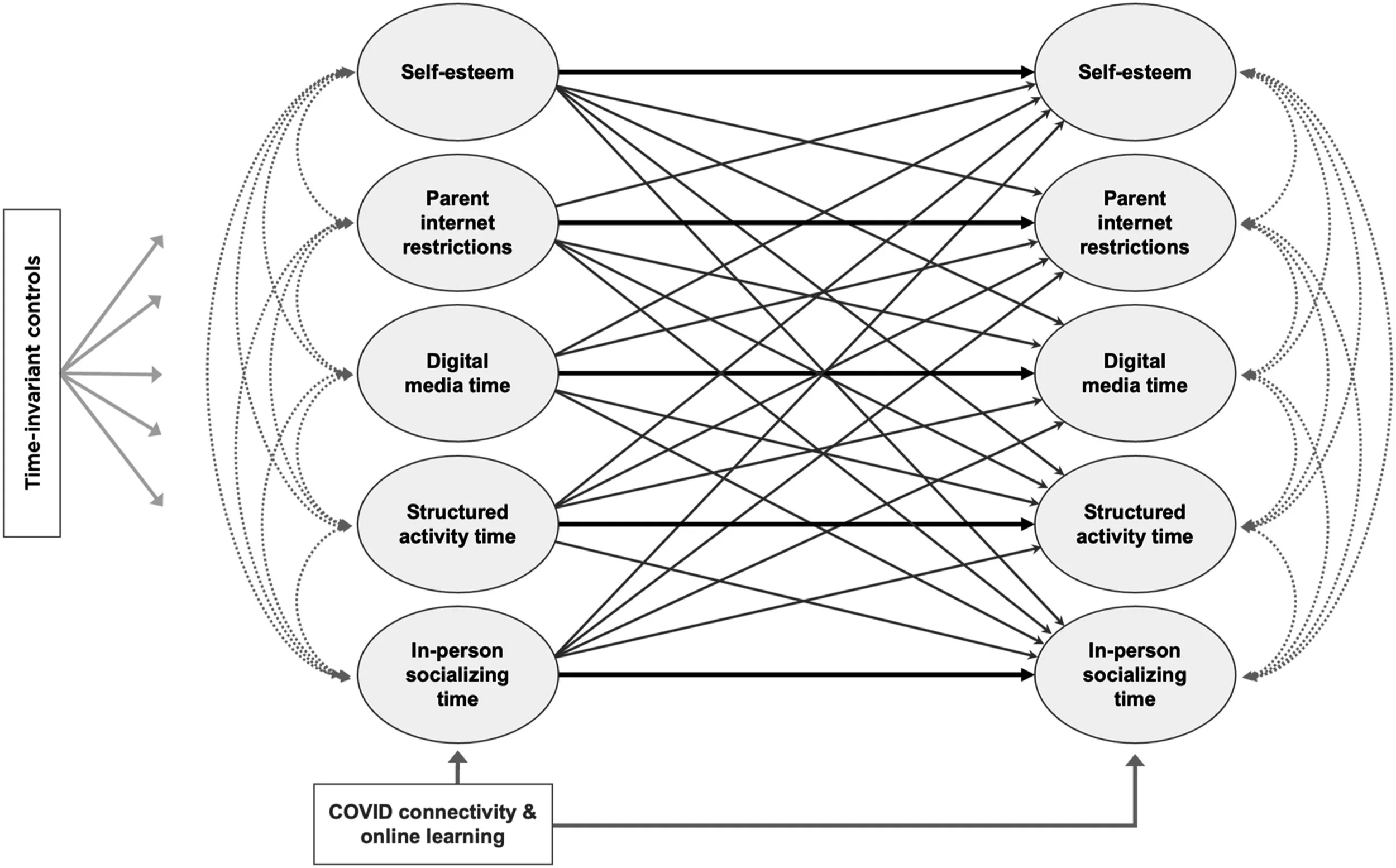
Figure 1. Conceptual CLPM
Key findings
Social media use was prospectively associated with higher self-esteem for girls.
Controlling for baseline self-esteem, girls who used more social media in early adolescence reported increased self-esteem in late adolescence, a medium-to-large positive relationship (β=.11). For boys, there was no significant relationship. We found no evidence of a reciprocal relationship; prior self-esteem did not predict later social media use.
Notably, an ad hoc analysis revealed that this relationship was significant only when controlling for changes in other social activities.
Among girls, social media use was associated with less time with family, not friends.
Girls with higher early social media use reported decreased time with family (β=−.13), but not with friends. For boys, more time playing video games was prospectively associated with decreased family time (β=−.16), but not time with friends. We found no evidence that social media use was related to reduced time with friends for either girls or boys.
These findings are consistent with established developmental models of adolescence: young people exchange time interacting with family for time spent interacting with peers (Coleman, 1961). We find no evidence of any short-term, small, negative effect accumulating into long-term harms related to self-esteem. Instead, the experience of social media use over adolescence appears to support self-esteem over time.
Benchmarking social media use
Effect sizes in the study of social media have been interpreted almost exclusively against discipline-specific thresholds (e.g., Cohen, 1992), which often lack context and practical meaning. A recommended alternative is internal benchmarking: comparing the magnitude of a relationship against another established, substantive predictor of the same outcome (André, 2022; Lipsey & Hurley, 2009). Our study offers two such benchmarks:
The COVID-19 pandemic: The midpoint of our three-year study coincided with the COVID-19 pandemic. We found that more time spent learning from home during pandemic lockdowns was prospectively associated with a large decrease in self-esteem, but only for girls (β=−.13). While social media use and COVID-19 lockdowns represent distinct phenomena, the positive prospective association between social media use and girls' self-esteem (β=.11) was comparable in magnitude—and opposite in direction—to the negative prospective association observed with pandemic stay-at-home orders.
Gender: The magnitude of both associations is also similar to the difference in self-esteem reported between boys and girls from early to late adolescence (β=−.10 for girls).
These benchmarks provide additional confirmation of the relatively large, positive prospective association between social media use and adolescent girls' self-esteem over time.
Implications
Well-being during adolescence depends heavily on opportunities for voluntary, unstructured social interaction with peers. Whether these interactions take place in person or through digital spaces, they generally protect against internalizing behaviors and support long-term psychological resilience. This does not imply that social media is a replacement for in-person contact. However, given long-standing structural trends that increasingly restrict youth autonomy and unstructured contact with peers, digital interactions can serve as a functional "stand-in,” supplementing and preserving opportunities for peer connection rather than displacing them.
Concluding that social media poses an inherent or "profound risk of harm" to youth mental health is not only premature but risks prompting counterproductive policy responses. When contextualized alongside multi-decade societal shifts, our findings suggest that social media use is not the primary engine of adolescent distress. Rather, digital media use is an adaptive response to systematic constraints on unstructured peer socializing.
The widespread resonance of the digital harm narrative may stem, in part, from how neatly it aligns with intensive parenting and educational paradigms that prioritize structured achievement over unstructured leisure. Enacting policies that restrict access to digital environments without addressing the underlying loss of autonomy inadvertently removes a critical buffer against internalizing symptoms. Rather than causing an adolescent mental health crisis, social media provides a vital space where young people maintain relationships and build self-esteem.
Read the full paper
Hampton, K. N., & Hales, G. E. (2026). The constrained generation: A longitudinal study of adolescent self-esteem and the misattribution of harm to social media. SAGE Open, 16(4), 1–22. https://doi.org/10.1177/21582440261505080
The paper is open access; full references for all works cited here are available in the paper. For related work from this same project, see Hampton and Shin (2023) on disconnection and adolescent self-esteem, and Hales and Hampton (2026) on screen time, digital skills, and academic achievement.
Thanks for reading.